
Date: January 27, 2026
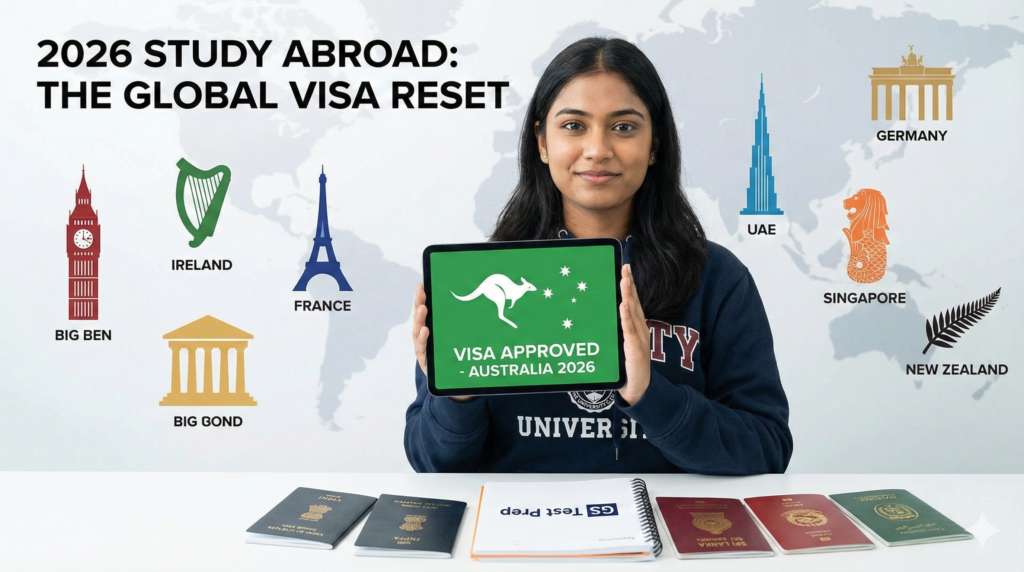
The global landscape for international students has shifted gears. As we move into the first major intake cycle of 2026, the era of “easy entry” has been replaced by an “Integrity Reset.” For students from India, Sri Lanka, Nepal, and Pakistan, the stakes have never been higher. Governments are no longer just looking for students who can pay; they are looking for Genuine Students who can contribute to their economies.
The most seismic shift occurred just days ago. On January 8, 2026, the Australian Department of Home Affairs (DHA) finalized its massive Evidence Level re-classification, moving several South Asian source regions into higher-risk categories. This coincides with the full-scale enforcement of the Genuine Student (GS) test, a rigorous AI-driven screening process that replaces the old GTE requirement. If you are planning to study abroad this year, this update—and the country-by-country shifts below—will dictate your success.
The new GS test is designed to verify that an applicant’s primary purpose is a high-quality education, not just a backdoor to the labor market.
- AI-Driven Screening: Applications are now scanned by AI for “canned” or plagiarized Statements of Purpose (SOPs).
- Increased Interviews: There is a 300% increase in random phone interviews for South Asian applicants. You must explain your course units and “Return on Investment” on the spot.
- Evidence Level 3 Scrutiny: Students from re-classified regions (including parts of India and Nepal) now face mandatory “Financial Forensic” audits.
What Students Should Do Now
- Prepare a “Source of Wealth” Trail: It is no longer enough to show money in a bank. You must show 12 months of stable funds or a clear legal trail of sold assets (e.g., land sale deeds).
- Verify Your Degree: Ensure your previous qualifications are from accredited institutions; Australia is manually verifying every Indian degree following a spike in counterfeits.
- Master Your Syllabus: Before your visa interview, know your specific modules, university location, and why that specific city (like Adelaide or Parramatta) fits your career goal.
Country-by-Country Roundup (Jan 2026)
United Kingdom
- Maintenance Hike: As of 11 Nov 2025, you need £1,529/month for London and £1,171/month outside.
- Graduate Route Warning: The post-study work visa will drop from 2 years to 18 months starting 1 Jan 2027. Students applying in 2026 are the last cohort to safely secure the full 2-year term.
New Zealand
- More Work Hours: Eligible students can now work 25 hours per week (up from 20) as of 3 Nov 2025.
- Quality Benchmarks: From 2026, visas are increasingly linked to providers that meet upgraded academic quality benchmarks.
Germany
- Blocked Account: The amount remains €11,904/year for 2026. This is based on the stable Bafög rate of €992/month.
- Opportunity Card: For job seekers, the requirement is higher at €1,091/month.
Ireland
- Increased Grants: Postgraduate fee contribution grants increased to €4,500 in Jan 2026.
- Maintenance: Expect to show at least €10,000 for courses longer than 8 months.
France
- Language & Civil Exams: Effective 1 Jan 2026, new residence permit applicants must pass a “Republican Values” civil test and meet higher French levels (A2 for workers, B2 for citizenship).
UAE & Singapore
- UAE Golden Visa: Top university graduates (Global Top 100) can now apply for 10-year residency without a sponsor.
- Singapore Digitalization: All Student’s Passes are now issued as digital OpenAttestation (OA) files via FileSG; physical cards are a thing of the past.
For Indian, Sri Lankan, Nepali, and Pakistani Students
In 2026, nationality-specific risks have evolved. Indian students are the primary focus of the Australian “Fake Degree” crackdown. Nepali students must provide the most extensive financial history (12 months of statements) due to high Evidence Level 3 re-classification. Pakistani and Sri Lankan students are seeing higher success rates in Germany and France, provided they meet the new 2026 language proficiency standards.
Frequently Asked Questions (FAQ)
What Changed: The Australia GS Test & Integrity Reset
It shortens to 18 months for applications made on or after 1 Jan 2027.
No, the cap is 48 hours per fortnight while the course is in session.
It is 25 hours per week.
No, it remains at €11,904/year.
The old SOP is replaced by specific questions in the ImmiAccount portal.
Yes, if the excellence criteria are still met.
Conclusion
The “Integrity Reset” of 2026 means your application must be airtight. Whether it’s the new GS test in Australia or the higher maintenance funds in the UK, the margin for error has disappeared.
Sources
- UKCISA: Changes to Student and Graduate Rules
- GOV.UK: Student Visa Financial Requirements
- SUSI Ireland: Budget 2026 Changes
- Buch-dein-Visum: New French Immigration Rules 2026
- Expatrio: German Blocked Account 2026
- ICP UAE: Golden Residency Services
- ICA Singapore: Digital Student Pass FAQ
- Rights and Associates: Mastering the 2026 Australian GS Test
- Australian DHA: Subclass 500 Visa Details
- Business Today: New Zealand 25-Hour Work Rule
Disclaimer: This content was generated with the aid of AI tools and is based on the latest available information as of the date of publication. While we strive for accuracy, immigration rules change frequently. Please consult with a certified counselor or the relevant government website before making visa applications.