
Communication Team

UK International Education Strategy 2026 impact analysis on students universities and education agents

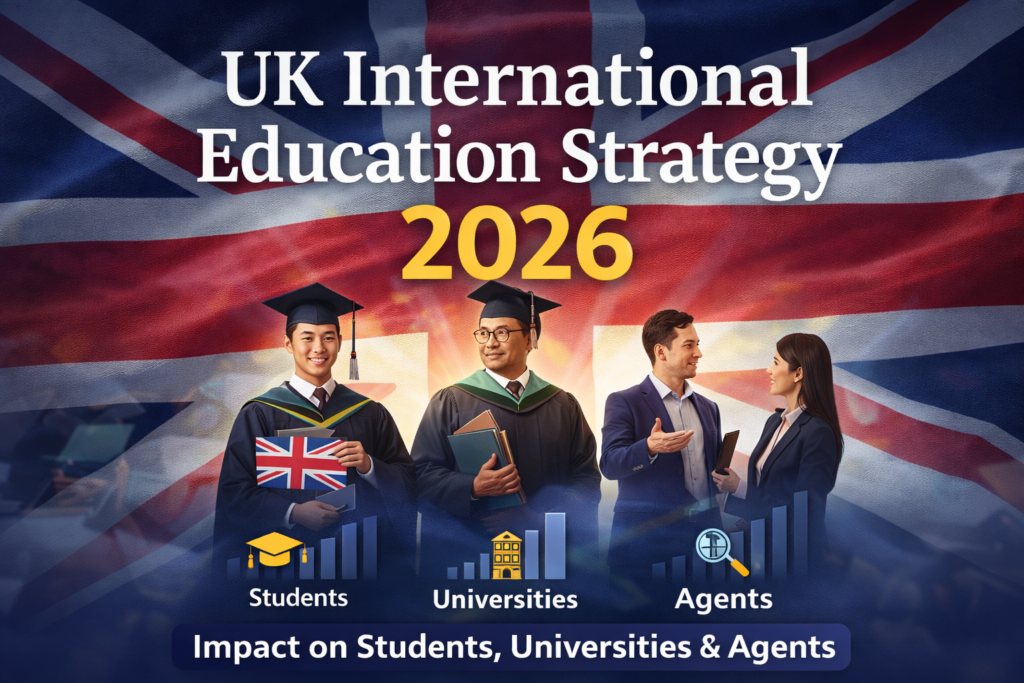
Impact Assessment of the UK International Education Strategy 2026

A Strategic Impact Assessment for Students, Universities, and Education Agents The UK International Education Strategy 2026 marks a decisive shift in how the UK engages with international students and global education partners. Rather than focusing purely on growth in numbers, the strategy prioritises quality, compliance, outcomes, and long-term sustainability. This policy is not restrictive — it is selective. In this article, we break down the real impacts of the strategy on: Using data-backed visual analysis, we explain who benefits, who faces risk, and how stakeholders must adapt. Impact on International Students What Changes for Students? For genuine international students, the 2026 strategy is largely positive. The focus shifts towards: Students who choose the UK for education and employability, rather than migration loopholes, stand to gain the most. Key Takeaways for Students Impact on UK Universities A Shift from Volume to Value UK universities now face heightened accountability. The strategy rewards institutions that demonstrate: Universities that rely heavily on volume-driven recruitment face greater scrutiny. University Risk vs Opportunity Matrix Key Takeaways for Universities Impact on Education Agents The End of Volume-Only Models The strategy significantly reshapes the agent ecosystem. UK authorities and universities now demand: Agent Models vs Sustainability Key Takeaways for Agents Who Benefits the Most from the Strategy? Ultimately, the policy favours quality participants across the ecosystem. Stakeholder Benefit Comparison Final Strategic Insight The UK International Education Strategy 2026 is not about reducing international education — it is about protecting its integrity. The new hierarchy is clear: Stakeholders who adapt early will gain long-term stability, trust, and growth. Those who resist change will face increasing friction and regulatory pressure. Conclusion For students, universities, and agents alike, the message is unmistakable: The future of UK international education belongs to those who prioritise quality, transparency, and outcomes. Frequently Asked Questions (FAQs) AI-Generated Analysis Notice This article and its analytical insights were generated with the assistance of Artificial Intelligence (AI). The AI was used to summarise, interpret, and visually analyse publicly available policy information to support understanding of the UK International Education Strategy 2026. While every effort has been made to ensure accuracy and clarity, the analysis should be interpreted as an informational and analytical perspective, not as official government guidance or legal advice. The conclusions, visualisations, and interpretations presented in this article are independent analytical outputs and do not represent the views of the UK Government or any associated public authority. Primary Source Document The analysis is based on the official UK Government publication: UK Department for Education. International Education Strategy 2026. Available at: https://assets.publishing.service.gov.uk/media/696a6164448fedc1eb4248ef/international-education-strategy-2026.pdf Readers are encouraged to refer to the original policy document for authoritative and up-to-date information.

Impact Assessment of the UK International Education Strategy 2026 Read More »

Indian travelers at airport celebrating Germany transit visa waiver 2026 with passports and luggage

Germany Drops Transit Visa for Indians – What Agents Need to Know

Germany Drops Transit Visa for Indians – What Agents Need to Know Date: January 13, 2026 Colleagues, we finally have the news we have been waiting for. For years, booking students or clients on Lufthansa via Frankfurt or Munich has been a calculated risk. The complex exemptions for the “Airport Transit Visa” (ATV) often led to confusion at check-in, off-loaded passengers, and frantic last-minute calls from the airport. That friction ends now. As of January 2026, Germany has officially abolished the Airport Transit Visa requirement for all Indian nationals. The Operational Shift: “Lufthansa is Back” Previously, many agents (rightfully) steered students toward Middle Eastern carriers (Emirates, Qatar, Etihad) or direct flights to avoid the German visa hassle. With this waiver, the India ➡️ Germany ➡️ USA/UK/Canada route is now a prime contender again. Why pitch this to your clients? Critical Client Advisory (Protect Your Liability) While this is a “blanket waiver,” it is not a “blanket entry.” To avoid liability claims or angry parents, you must clarify the following limitations to every client booking a German itinerary: 1. The “Single Ticket” Rule The waiver applies only if the baggage is checked through to the final destination. 2. The “Transit Area” Trap Ensure your clients understand they cannot leave the international transit zone. 3. The “Double Stop” Danger This is the most common mistake. A flight itinerary that stops in two Schengen cities (e.g., Mumbai ➡️ Munich ➡️ Frankfurt ➡️ USA) is NOT allowed without a full Schengen visa. Citations & Verification AI & Accuracy Disclaimer: This update was generated using AI tools based on the latest available news reports as of January 2026. While we strive for accuracy, visa policies can change overnight. Please always verify the latest regulations directly with the German Embassy or your airline before booking.

Germany Drops Transit Visa for Indians – What Agents Need to Know Read More »

Germany’s New Visa Portal: A Digital Shift in the Visa Process

On January 1, 2025, Germany launched the Consular Services Portal, a fully digital visa application system rolled out across all 167 visa sections of German missions worldwide. This marks a major shift from paper-heavy, in-person first steps toward a more streamlined, online-first approach. Below is a detailed look at what this portal is, what it changes, and what you need to know. What Is the Consular Services Portal Key Features & How It Works Here’s how the new process generally works, and what’s different from the old one: Step What You Do Now via Portal What Was Different / Old Process Register / Initial Setup Create an account on the portal; can do this from computer, phone, tablet.  Previously, many applications started with in-person visits or filling out physical forms at embassy/VFS, etc. Document Upload / Forms Upload required documents digitally; fill out forms online.  Physical drop-off or mailing of supporting documents, more back-and-forth. Preliminary Review German mission reviews application documents first; if something is missing, they inform you online so you can correct or complete.  In many cases, applicants found out missing documents only at appointment or later, causing delays. Appointment / Biometrics Once your online submission is deemed “complete enough,” you schedule an in-person appointment for biometrics, verification of originals, fee payment etc. Appointment usually scheduled earlier, sometimes long waits, with less certainty whether documents were in order. Status Tracking You can track application status online via the portal. Before, tracking was through embassy/VFS contact, may not have been centralized or transparent. Benefits & What’s Improved Things to Be Careful About / Possible Challenges What This Means for Indian Applicants Since you are in India, here are the specifics from the Indian mission side (as of early 2025): Opportunity CardBlue Card (EU)Employment as academicSkilled worker (with professional training)Work with experienceQualification assessmentStudent visaVocational training etc. Tips for Applicants In Summary Germany’s Consular Services Portal represents a significant modernization of its visa system. For many applicants, this means: But it doesn’t eliminate the need for detailed preparation, meeting mission-specific requirements, and completing in-person steps for biometrics. If you’re planning to study, work, or stay long-term in Germany, this portal makes the process more transparent and manageable — provided you use it properly. Sources

Germany’s New Visa Portal: A Digital Shift in the Visa Process Read More »

Important UK Visa Updates: Increased Maintenance Funds (Nov 2025) & Graduate Route Changes (Jan 2027)

The UK Home Office has announced two major updates affecting international students — an increase in maintenance funds effective 11 November 2025 and changes to the Graduate Route duration effective 1 January 2027. 1. Maintenance Requirement Increase – Effective 11 November 2025 Starting 11 November 2025, students applying under the Student Route must show higher financial evidence to meet visa requirements. The updated figures are intended to reflect the rising cost of living in the UK. Updated Maintenance Amounts: This means that a student applying to a London-based institution will now need to show up to £13,761 (£1,529 × 9 months) in living costs, while those outside London must show £10,539 (£1,171 × 9 months). What This Means for Students: 2. Graduate Route Duration Changes – Effective 1 January 2027 The UK’s Graduate Route, which allows international students to stay and work (or look for work) after completing their studies, is undergoing a duration revision. Updated Stay Periods: Key Takeaways: How Uniexperts Can Help You Plan At Uniexperts, we stay ahead of every immigration and education update to guide our students and partners accurately. Our experienced counsellors can help you: ✅ Plan financial documents to meet the new maintenance requirements ✅ Choose cost-effective study destinations outside London if budget is a concern ✅ Understand how the new Graduate Route timeline fits your career plans ✅ Prepare your visa file and post-study work options well before these rules take effect Summary of Changes Rule Change Effective Date Key Update Impact Maintenance Funds 11 Nov 2025 £1,529 (London) / £1,171 (Outside London) Higher financial proof required Graduate Route Duration 1 Jan 2027 18 months for UG/PG students Shorter post-study stay period Source: UKCISA – Student Update: Changes to the Student and Graduate Rules , Immigration Rules Changes PDF Disclaimer The information provided in this article is for general guidance only and is based on official updates available as of October 2025. Immigration rules and policies are subject to change by the UK Home Office without prior notice. Applicants are strongly advised to verify all details from official government sources or consult with a licensed immigration advisor before making any visa-related decisions. Uniexperts assumes no responsibility for any errors, omissions, or actions taken based on this information.

Important UK Visa Updates: Increased Maintenance Funds (Nov 2025) & Graduate Route Changes (Jan 2027) Read More »

Indian Students Drive UK Study Visa Growth Amid Stricter Rules

The UK continues to be one of the world’s most attractive destinations for higher education. In 2025, Indian students are at the center of this success story. Despite tighter immigration rules and a sharp decline in dependant visas, India has emerged as the leading driver of UK study visa growth. 📊 Key Numbers: UK Study Visas in 2025 According to the UK Home Office (year ending June 2025): 431,725 sponsored study visas were granted — down 18% from 2024 but still 52% higher than pre-COVID 2019 levels. 413,921 were main applicants, representing a 4% decline from 2024. 17,804 were dependants, marking an 81% drop after the January 2024 policy restricted dependant eligibility to PhD students and government-funded scholars. Among main applicants, Indian students secured 98,014 visas, nearly matching Chinese students at 99,919. Together, India and China accounted for almost half of all UK study visas issued in 2025. 🎓 Indian Students Favor Postgraduate Programs A standout trend is India’s clear preference for postgraduate education: 81% of Indian students enrolled in master’s programs. In comparison, 59% of Chinese students opted for postgraduate studies. This reflects a career-focused approach, with Indian students viewing UK universities not just as academic institutions but as launchpads for global opportunities. 🌍 Changing Policy, Changing Student Profile The sharp decline in dependant visas has reshaped the UK’s international student demographic: Fewer families are migrating alongside students. The incoming student population is increasingly academically focused. Postgraduate enrolments are driving overall growth, highlighting a career-driven mindset. While these policy changes reduced total numbers, they strengthened the UK’s reputation as a destination for serious academic and professional advancement. 💡 Why Indian Students Still Choose the UK Even with stricter visa rules and higher living costs, Indian students continue to see strong value in studying in the UK because of: Globally recognized master’s programs Advanced curriculum and rich research opportunities The Graduate Route, offering 2–3 years of post-study work rights The UK’s global reputation for employability and career progression 🌐 The Bigger Picture: Comparing the Big Four Study Destinations While the UK attracts Indian students with a streamlined visa process and post-study work opportunities, other popular destinations are facing challenges: Canada: Tighter eligibility rules, stricter proof-of-funds requirements, and rigorous academic checks are causing delays. Australia: IT system issues and documentation delays through the ImmiAccount system are slowing visa approvals. USA: Limited visa appointments, fluctuating immigration policies, and ongoing H-1B uncertainties create unpredictability for long-term planning. United Kingdom: In contrast, the UK remains welcoming, predictable, and career-focused, making it a top choice for Indian students seeking global education and professional growth. 🔮 The Road Ahead For UK universities, the challenge will be to balance policy restrictions with global competitiveness, ensuring that ambitious Indian students continue to see the UK as their first-choice destination. Indian students are no longer just participants in the UK’s international education story — they are leading it. Their dominance in postgraduate enrollments and career-oriented outlook is reshaping the landscape of UK higher education.

Indian Students Drive UK Study Visa Growth Amid Stricter Rules Read More »

Global Student Recruitment: What Europe Can Learn from Other Study Destinations

At the recent European Association for International Education (EAIE) conference in Gothenburg, education leaders issued a timely warning: Europe should tread carefully when it comes to international student recruitment. With policy restrictions in traditional study hubs like the US, UK, Canada, and Australia, Europe is increasingly seen as an attractive alternative – but not without potential challenges. The Changing Landscape of International Student Mobility Nick Golding, co-founder and CEO-designate of the Global Education Recruitment Standards Authority (GERSA), highlighted how anti-immigration sentiment and policy restrictions in major destinations are redirecting students to new territories. However, he cautioned that countries must be prepared for the social and political consequences of sudden increases in student numbers. “If there’s any lesson to be learned from Canada, the UK, and Australia, it is that the social license of international students, and indeed the institutions recruiting them, can quickly become forfeited or impaired,” Golding told delegates. His advice was clear: Europe should learn from the mistakes of others to avoid backlash at both local and policy levels. Policy Pressure in Key Destinations Golding’s comments come in the wake of major policy shake-ups: These push factors make Europe appear more welcoming and cost-effective to international students. Yet, without a considered approach, the benefits may be overshadowed by social tensions and political reaction. The Role of Education Agents A significant part of the discussion focused on education agents, who play a critical role in shaping the international student pipeline. Phil Honeywood, CEO of the International Education Association of Australia (IEAA), noted that the majority of international students in Australia are recruited through agents. During the pandemic, this process became even more competitive, creating what he described as a “wild frontier.” However, he stressed that accountability lies with both parties. “You can’t have a bad agent without a badly behaved education provider,” Honeywood explained. Naresh Gulati, CEO of Ascent One and a former international student, echoed this sentiment. He argued that agents are often blamed unfairly when in reality, poor recruitment practices are a shared responsibility. “If a shonky provider appoints a shonky agent, the student is going to suffer,” he said. The Promise of Technology and AI Looking ahead, panellists also discussed how technology could reshape international student recruitment. Gulati pointed out that artificial intelligence could be used to identify genuine students and filter out fraudulent applications. This, he suggested, could enhance integrity in the recruitment process while also strengthening trust between institutions, agents, and students. What Europe Should Do Next As Europe positions itself as a leading education destination, the lessons from North America and Australia are clear. Unchecked recruitment growth may win short-term gains, but long-term sustainability depends on responsible strategies. Transparency in agent partnerships, careful policy planning, and the use of innovative technologies like AI can help Europe build an ethical and balanced international student ecosystem. The takeaway is simple: growth should never come at the cost of credibility. Europe now has a chance to learn from the mistakes of others—and set new global standards in international education recruitment. Sources:• The PIE News – “Lessons from Canada, UK and Australia for Europe to learn” (EAIE 2025 panel coverage)• EAIE (European Association for International Education) Conference Proceedings, Gothenburg 2025

Global Student Recruitment: What Europe Can Learn from Other Study Destinations Read More »

🇫🇷 VLS-TS Explained: Why France’s Student Visa Is the Strongest in Europe

When students think of Europe, they often compare Germany or Netherlands. But there is one visa that stands out as the most student-friendly, financially supportive, and future-oriented: the French VLS-TS (Visa Long Séjour valant Titre de Séjour). This visa is more than a simple study permit—it is your gateway to education, work, social benefits, European travel, and even long-term residency. Let’s dive deep into why the VLS-TS is the best student visa in Europe. 🎓 1. Study in France, Live Like a Local In many destinations, being an international student means living on the sidelines—restricted rights, limited benefits, and higher costs than locals. France breaks that pattern. With the VLS-TS student visa, you step into the country as a recognized resident, not a temporary visitor. 💼 2. Work Legally While You Study The VLS-TS gives you the right to work part-time 964 hours per year (20 hours per week)—enough to support living costs while gaining experience. Paid internships are fully allowed. Many French programs (especially Masters/MBA) include mandatory internships, making your work experience official and valuable. Students in France also enjoy a minimum wage protection (SMIC). 👉 Compare this to the UK where hours are limited during term time and student jobs are harder to find—France clearly offers more balance between study and work. 🏠 3. CAF Housing Allowance (A Benefit Rarely Found Elsewhere) One of the most powerful advantages of studying in France is access to CAF (Caisse d’Allocations Familiales) housing aid. International students can claim 30–40% rent reduction each month. Applies to both student residences (CROUS) and private apartments. No discrimination: French and international students get the same benefit. 💡 Few countries in Europe directly subsidize student rent for foreigners—France does. ❤️ 4. Health Insurance Like a Citizen With the VLS-TS, you’re automatically eligible for the French national healthcare system (Sécurité Sociale Étudiante): Free or low-cost enrollment. Covers doctor visits, hospitals, prescriptions, and partial dental/eye care. You can also add private student insurance (“mutuelle”) for extra coverage. Compare this to the US (where insurance costs $1,000s) or the UK (where you pay a high NHS surcharge)—France offers world-class healthcare nearly free of charge. 🌍 5. Free Travel Across Europe The VLS-TS is a Schengen visa. This means: You can freely travel across 26+ Schengen countries (Germany, Spain, Italy, Switzerland, etc.) during your studies. Perfect for weekend trips, cultural exposure, and building global networks. Your French student life is not just in France—it’s in all of Europe. 🔑 6. A Clear Path to PR and Citizenship Unlike in many countries, the French VLS-TS visa is not a dead end—it’s the first step towards permanent settlement. 📌 Popular Post-Study Pathways Pathway Eligibility Validity Work Rights Key Advantage RECE (Job Seeking) Master’s degree, recent graduate, or APS holder Up to 12 months ❌ No Counts toward 5-year residency Salarié (Employee) CDI or qualifying CDD; ≥1.5 × SMIC salary Typically 1 year (renewable) ✅ Yes Employer-sponsored; pathway to PR Talent Passport – Young Graduate Master’s+ degree, innovative employer, high salary Multi-year ✅ Yes Smooth route; high salary & innovation requirement Citizenship opportunity: After 5 years of PR or 10 years of residence, you may be eligible to apply for French nationality. ⚖️ 7. Almost Equal to Citizens (Even Before PR) Even while on VLS-TS, you already enjoy rights similar to French citizens: Affordable tuition fees. Access to CAF rent subsidies. Coverage under national health insurance. Discounts on transportation, museums, theaters, cinemas, and restaurants. Right to work part-time with legal protections. Equal access to public libraries, sports facilities, and student unions. In short: You live like a French student citizen from day one. ✨ Final Word The VLS-TS student visa is not just an entry ticket to French universities—it’s a comprehensive package of rights and opportunities that few other countries offer. From subsidized housing and healthcare to legal work, Schengen travel, dependent benefits, and a clear path to PR and citizenship, it is no exaggeration to say: “The French VLS-TS is the strongest and most student-friendly visa in Europe”.

🇫🇷 VLS-TS Explained: Why France’s Student Visa Is the Strongest in Europe Read More »

UAE Sees Record 90% Surge in International Student Interest in 2025

The United Arab Emirates is witnessing a historic boom in international student interest, with new data from Keystone showing a 90% year-on-year surge in June alone. The UAE now captures 59% of all MENA study destination searches, firmly outpacing its regional rivals and positioning Dubai as the new global education hotspot. Dubai’s Growing Appeal Among South Asian Families At the heart of this rise is a major demographic shift. India continues to dominate as the largest source market, contributing 42% of Dubai’s international student population. Students from Pakistan, Singapore, Indonesia, France, Germany, and the United States are also increasingly prioritizing Dubai as their first-choice study destination. For Indian and South Asian families, Dubai offers unmatched convenience. A short flight from most major cities, combined with strong cultural and linguistic ties, makes the UAE both accessible and reassuring. Parents value the safety and connectivity, while students enjoy a multicultural environment that still feels familiar. Interestingly, this surge isn’t limited to postgraduate applicants. “We’re seeing Indian families now looking at Dubai for undergraduate studies as well—it’s about quality, comfort, and affordability,” Policy Reforms Making Education More Accessible Government initiatives have played a decisive role in fueling the UAE’s education boom. The Ministry of Higher Education and Scientific Research (MoHESR) has introduced reforms that dramatically cut red tape for applicants: These student-first policies have positioned the UAE as one of the most accessible and welcoming destinations for global learners. The Tax-Free Advantage Beyond admissions, Dubai’s tax-free economy is a game-changer. Unlike the US, UK, or Australia—where international graduates face significant tax deductions—students in the UAE start their careers without income tax burdens. For families making substantial investments in education, this translates into: This unique financial advantage is increasingly tipping the scales in favor of Dubai over traditional Western destinations. Why Students Choose Dubai Over “HQ” Campuses Abroad While many top universities operate both in Dubai and in their home countries, Dubai campuses are offering distinctive advantages that are hard to overlook: For students and families, this combination makes Dubai a smarter, more future-proof investment. Outlook: Dubai as a Global Education Launchpad With sustained government backing, bold internationalization strategies, and an education model that blends affordability, accessibility, and career opportunity, Dubai is fast becoming the Middle East’s premier higher education hub. “Dubai isn’t just an education destination—it’s a springboard for global careers,” said Suneet Singh Kochar, CEO of Fateh Education. As global demand for quality, cost-effective, and career-ready education grows, Dubai’s meteoric rise signals more than a regional trend—it’s shaping a new paradigm in international higher education. Sources: Ministry of Higher Education and Scientific Research (MoHESR), UAE Education Reforms, 2025 and Gulf News, “Dubai’s Rise as a Global Education Hub,” July 2025.

UAE Sees Record 90% Surge in International Student Interest in 2025 Read More »

Japan’s Educational System: A Complete Guide for International Students

Japan has long been admired for its combination of academic excellence, technological innovation, and career-focused training. With world-class universities, a strong vocational sector, and affordable tuition compared to many Western countries, Japan continues to attract international students seeking high-quality education and cultural immersion. This guide explains the structure of the Japanese education system—covering compulsory schooling, higher education options, costs, and why it is a top choice for global learners. 1. Compulsory Education (Ages 6–15) In Japan, nine years of education are compulsory: While High School (3 years, ages 15–18) is not legally compulsory, nearly all students attend, reflecting Japan’s strong emphasis on academic achievement. 📖 Source: Study in Japan – Educational System 2. Senior Secondary & Higher Education Pathways (Ages 15+) After compulsory education, Japanese students can choose between academic research-oriented routes or practical skills and vocational tracks. (a) Academic Pathway 📖 Source: Study in Japan – Graduate Schools (b) Practical & Vocational Pathway 📖 Source: Study in Japan – Educational System 3. Dual Orientation: Research vs. Practical Skills Japan’s education system is designed to balance: This dual-track structure ensures Japan develops both world-class researchers and highly skilled professionals for the workforce. 📖 Source: MEXT – Ministry of Education, Culture, Sports, Science and Technology 4. Costs of Higher Education in Japan Japan offers affordable tuition compared to countries like the US, UK, and Australia. Estimated first-year costs (including tuition, fees, etc.) are: Institution Type Estimated Cost (First Year) National University ¥820,000 (~USD 5,500) Public University ¥900,000 (~USD 6,000) Private University ¥1,100,000 (~USD 7,500) International students can also apply for MEXT Scholarships, which cover tuition, living expenses, and travel costs. 📖 Source: Study in Japan – Graduate Schools 5. Why Choose Japan as a Study Destination? Conclusion Japan’s education system is a comprehensive and flexible structure: For international students, Japan offers an unmatched blend of quality education, affordability, career opportunities, and cultural immersion. Whether you aim to become a researcher, engineer, educator, or global professional, Japan provides a structured pathway to achieve your goals. 📖 Official Sources:

Japan’s Educational System: A Complete Guide for International Students Read More »