
Europe

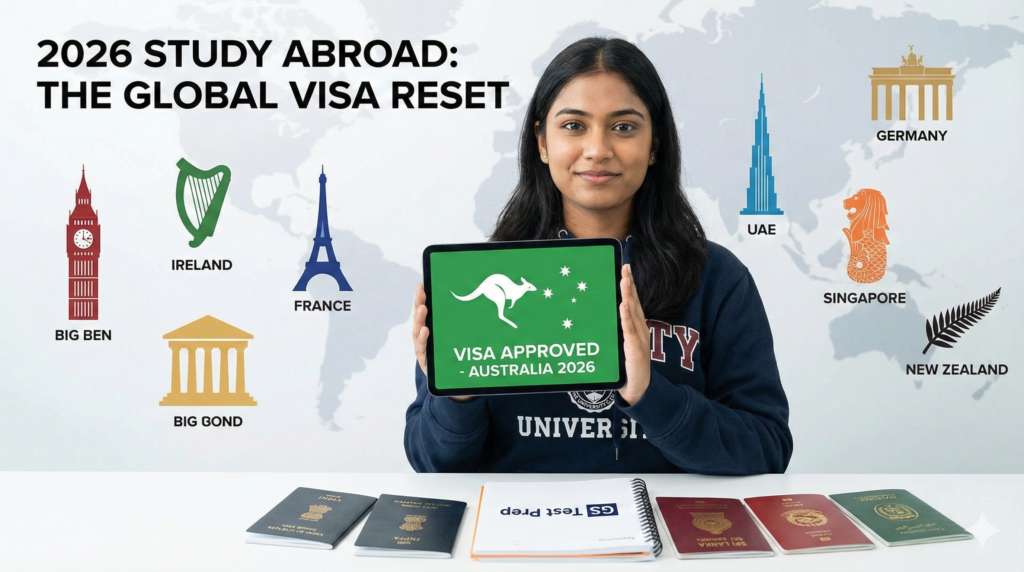
South Asian student celebrating Australia student visa approval 2026 on tablet with Sydney Opera House background

The 2026 Study Abroad Reset: Navigating Australia’s New GS Test and Global Visa Shifts

Date: January 27, 2026 The global landscape for international students has shifted gears. As we move into the first major intake cycle of 2026, the era of “easy entry” has been replaced by an “Integrity Reset.” For students from India, Sri Lanka, Nepal, and Pakistan, the stakes have never been higher. Governments are no longer just looking for students who can pay; they are looking for Genuine Students who can contribute to their economies. The most seismic shift occurred just days ago. On January 8, 2026, the Australian Department of Home Affairs (DHA) finalized its massive Evidence Level re-classification, moving several South Asian source regions into higher-risk categories. This coincides with the full-scale enforcement of the Genuine Student (GS) test, a rigorous AI-driven screening process that replaces the old GTE requirement. If you are planning to study abroad this year, this update—and the country-by-country shifts below—will dictate your success. The new GS test is designed to verify that an applicant’s primary purpose is a high-quality education, not just a backdoor to the labor market. What Students Should Do Now Country-by-Country Roundup (Jan 2026) United Kingdom New Zealand Germany Ireland France UAE & Singapore For Indian, Sri Lankan, Nepali, and Pakistani Students In 2026, nationality-specific risks have evolved. Indian students are the primary focus of the Australian “Fake Degree” crackdown. Nepali students must provide the most extensive financial history (12 months of statements) due to high Evidence Level 3 re-classification. Pakistani and Sri Lankan students are seeing higher success rates in Germany and France, provided they meet the new 2026 language proficiency standards. Frequently Asked Questions (FAQ) What Changed: The Australia GS Test & Integrity Reset Conclusion The “Integrity Reset” of 2026 means your application must be airtight. Whether it’s the new GS test in Australia or the higher maintenance funds in the UK, the margin for error has disappeared. Sources Disclaimer: This content was generated with the aid of AI tools and is based on the latest available information as of the date of publication. While we strive for accuracy, immigration rules change frequently. Please consult with a certified counselor or the relevant government website before making visa applications.

The 2026 Study Abroad Reset: Navigating Australia’s New GS Test and Global Visa Shifts Read More »
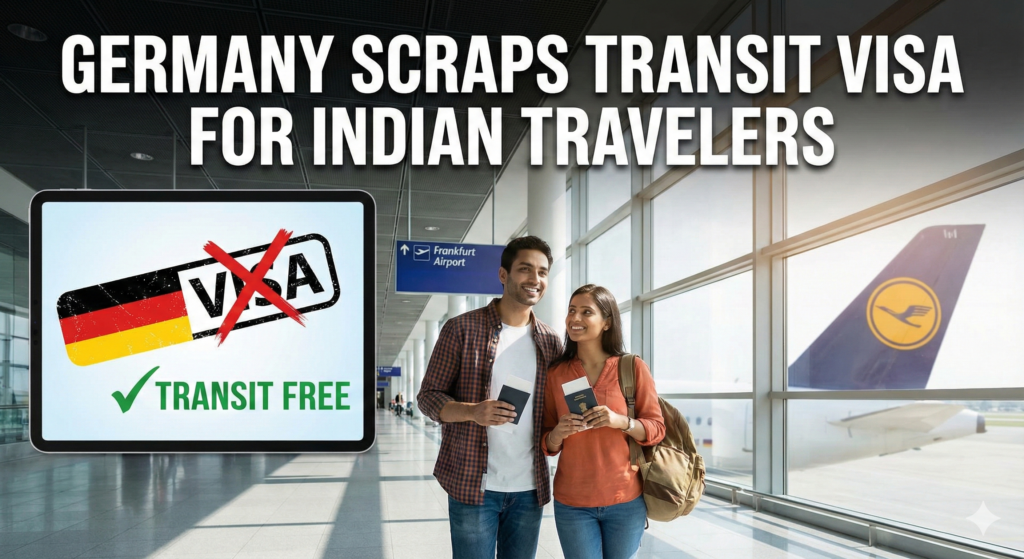
Indian travelers at airport celebrating Germany transit visa waiver 2026 with passports and luggage

Germany Drops Transit Visa for Indians – What Agents Need to Know

Germany Drops Transit Visa for Indians – What Agents Need to Know Date: January 13, 2026 Colleagues, we finally have the news we have been waiting for. For years, booking students or clients on Lufthansa via Frankfurt or Munich has been a calculated risk. The complex exemptions for the “Airport Transit Visa” (ATV) often led to confusion at check-in, off-loaded passengers, and frantic last-minute calls from the airport. That friction ends now. As of January 2026, Germany has officially abolished the Airport Transit Visa requirement for all Indian nationals. The Operational Shift: “Lufthansa is Back” Previously, many agents (rightfully) steered students toward Middle Eastern carriers (Emirates, Qatar, Etihad) or direct flights to avoid the German visa hassle. With this waiver, the India ➡️ Germany ➡️ USA/UK/Canada route is now a prime contender again. Why pitch this to your clients? Critical Client Advisory (Protect Your Liability) While this is a “blanket waiver,” it is not a “blanket entry.” To avoid liability claims or angry parents, you must clarify the following limitations to every client booking a German itinerary: 1. The “Single Ticket” Rule The waiver applies only if the baggage is checked through to the final destination. 2. The “Transit Area” Trap Ensure your clients understand they cannot leave the international transit zone. 3. The “Double Stop” Danger This is the most common mistake. A flight itinerary that stops in two Schengen cities (e.g., Mumbai ➡️ Munich ➡️ Frankfurt ➡️ USA) is NOT allowed without a full Schengen visa. Citations & Verification AI & Accuracy Disclaimer: This update was generated using AI tools based on the latest available news reports as of January 2026. While we strive for accuracy, visa policies can change overnight. Please always verify the latest regulations directly with the German Embassy or your airline before booking.

Germany Drops Transit Visa for Indians – What Agents Need to Know Read More »

Germany’s New Visa Portal: A Digital Shift in the Visa Process

On January 1, 2025, Germany launched the Consular Services Portal, a fully digital visa application system rolled out across all 167 visa sections of German missions worldwide. This marks a major shift from paper-heavy, in-person first steps toward a more streamlined, online-first approach. Below is a detailed look at what this portal is, what it changes, and what you need to know. What Is the Consular Services Portal Key Features & How It Works Here’s how the new process generally works, and what’s different from the old one: Step What You Do Now via Portal What Was Different / Old Process Register / Initial Setup Create an account on the portal; can do this from computer, phone, tablet.  Previously, many applications started with in-person visits or filling out physical forms at embassy/VFS, etc. Document Upload / Forms Upload required documents digitally; fill out forms online.  Physical drop-off or mailing of supporting documents, more back-and-forth. Preliminary Review German mission reviews application documents first; if something is missing, they inform you online so you can correct or complete.  In many cases, applicants found out missing documents only at appointment or later, causing delays. Appointment / Biometrics Once your online submission is deemed “complete enough,” you schedule an in-person appointment for biometrics, verification of originals, fee payment etc. Appointment usually scheduled earlier, sometimes long waits, with less certainty whether documents were in order. Status Tracking You can track application status online via the portal. Before, tracking was through embassy/VFS contact, may not have been centralized or transparent. Benefits & What’s Improved Things to Be Careful About / Possible Challenges What This Means for Indian Applicants Since you are in India, here are the specifics from the Indian mission side (as of early 2025): Opportunity CardBlue Card (EU)Employment as academicSkilled worker (with professional training)Work with experienceQualification assessmentStudent visaVocational training etc. Tips for Applicants In Summary Germany’s Consular Services Portal represents a significant modernization of its visa system. For many applicants, this means: But it doesn’t eliminate the need for detailed preparation, meeting mission-specific requirements, and completing in-person steps for biometrics. If you’re planning to study, work, or stay long-term in Germany, this portal makes the process more transparent and manageable — provided you use it properly. Sources

Germany’s New Visa Portal: A Digital Shift in the Visa Process Read More »

Global Student Recruitment: What Europe Can Learn from Other Study Destinations

At the recent European Association for International Education (EAIE) conference in Gothenburg, education leaders issued a timely warning: Europe should tread carefully when it comes to international student recruitment. With policy restrictions in traditional study hubs like the US, UK, Canada, and Australia, Europe is increasingly seen as an attractive alternative – but not without potential challenges. The Changing Landscape of International Student Mobility Nick Golding, co-founder and CEO-designate of the Global Education Recruitment Standards Authority (GERSA), highlighted how anti-immigration sentiment and policy restrictions in major destinations are redirecting students to new territories. However, he cautioned that countries must be prepared for the social and political consequences of sudden increases in student numbers. “If there’s any lesson to be learned from Canada, the UK, and Australia, it is that the social license of international students, and indeed the institutions recruiting them, can quickly become forfeited or impaired,” Golding told delegates. His advice was clear: Europe should learn from the mistakes of others to avoid backlash at both local and policy levels. Policy Pressure in Key Destinations Golding’s comments come in the wake of major policy shake-ups: These push factors make Europe appear more welcoming and cost-effective to international students. Yet, without a considered approach, the benefits may be overshadowed by social tensions and political reaction. The Role of Education Agents A significant part of the discussion focused on education agents, who play a critical role in shaping the international student pipeline. Phil Honeywood, CEO of the International Education Association of Australia (IEAA), noted that the majority of international students in Australia are recruited through agents. During the pandemic, this process became even more competitive, creating what he described as a “wild frontier.” However, he stressed that accountability lies with both parties. “You can’t have a bad agent without a badly behaved education provider,” Honeywood explained. Naresh Gulati, CEO of Ascent One and a former international student, echoed this sentiment. He argued that agents are often blamed unfairly when in reality, poor recruitment practices are a shared responsibility. “If a shonky provider appoints a shonky agent, the student is going to suffer,” he said. The Promise of Technology and AI Looking ahead, panellists also discussed how technology could reshape international student recruitment. Gulati pointed out that artificial intelligence could be used to identify genuine students and filter out fraudulent applications. This, he suggested, could enhance integrity in the recruitment process while also strengthening trust between institutions, agents, and students. What Europe Should Do Next As Europe positions itself as a leading education destination, the lessons from North America and Australia are clear. Unchecked recruitment growth may win short-term gains, but long-term sustainability depends on responsible strategies. Transparency in agent partnerships, careful policy planning, and the use of innovative technologies like AI can help Europe build an ethical and balanced international student ecosystem. The takeaway is simple: growth should never come at the cost of credibility. Europe now has a chance to learn from the mistakes of others—and set new global standards in international education recruitment. Sources:• The PIE News – “Lessons from Canada, UK and Australia for Europe to learn” (EAIE 2025 panel coverage)• EAIE (European Association for International Education) Conference Proceedings, Gothenburg 2025

Global Student Recruitment: What Europe Can Learn from Other Study Destinations Read More »