
UAE

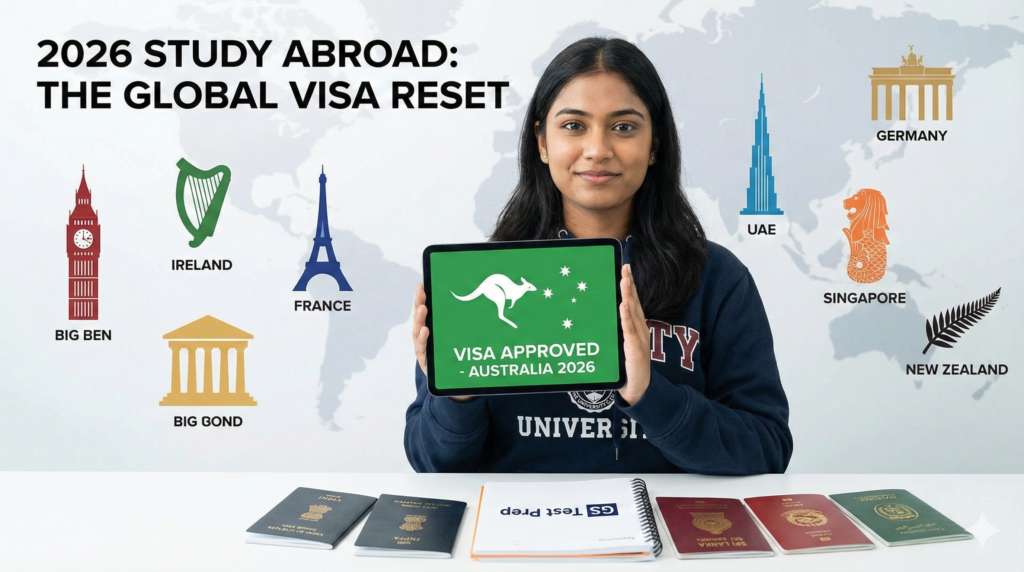
South Asian student celebrating Australia student visa approval 2026 on tablet with Sydney Opera House background

The 2026 Study Abroad Reset: Navigating Australia’s New GS Test and Global Visa Shifts

Date: January 27, 2026 The global landscape for international students has shifted gears. As we move into the first major intake cycle of 2026, the era of “easy entry” has been replaced by an “Integrity Reset.” For students from India, Sri Lanka, Nepal, and Pakistan, the stakes have never been higher. Governments are no longer just looking for students who can pay; they are looking for Genuine Students who can contribute to their economies. The most seismic shift occurred just days ago. On January 8, 2026, the Australian Department of Home Affairs (DHA) finalized its massive Evidence Level re-classification, moving several South Asian source regions into higher-risk categories. This coincides with the full-scale enforcement of the Genuine Student (GS) test, a rigorous AI-driven screening process that replaces the old GTE requirement. If you are planning to study abroad this year, this update—and the country-by-country shifts below—will dictate your success. The new GS test is designed to verify that an applicant’s primary purpose is a high-quality education, not just a backdoor to the labor market. What Students Should Do Now Country-by-Country Roundup (Jan 2026) United Kingdom New Zealand Germany Ireland France UAE & Singapore For Indian, Sri Lankan, Nepali, and Pakistani Students In 2026, nationality-specific risks have evolved. Indian students are the primary focus of the Australian “Fake Degree” crackdown. Nepali students must provide the most extensive financial history (12 months of statements) due to high Evidence Level 3 re-classification. Pakistani and Sri Lankan students are seeing higher success rates in Germany and France, provided they meet the new 2026 language proficiency standards. Frequently Asked Questions (FAQ) What Changed: The Australia GS Test & Integrity Reset Conclusion The “Integrity Reset” of 2026 means your application must be airtight. Whether it’s the new GS test in Australia or the higher maintenance funds in the UK, the margin for error has disappeared. Sources Disclaimer: This content was generated with the aid of AI tools and is based on the latest available information as of the date of publication. While we strive for accuracy, immigration rules change frequently. Please consult with a certified counselor or the relevant government website before making visa applications.

The 2026 Study Abroad Reset: Navigating Australia’s New GS Test and Global Visa Shifts Read More »

UAE Sees Record 90% Surge in International Student Interest in 2025

The United Arab Emirates is witnessing a historic boom in international student interest, with new data from Keystone showing a 90% year-on-year surge in June alone. The UAE now captures 59% of all MENA study destination searches, firmly outpacing its regional rivals and positioning Dubai as the new global education hotspot. Dubai’s Growing Appeal Among South Asian Families At the heart of this rise is a major demographic shift. India continues to dominate as the largest source market, contributing 42% of Dubai’s international student population. Students from Pakistan, Singapore, Indonesia, France, Germany, and the United States are also increasingly prioritizing Dubai as their first-choice study destination. For Indian and South Asian families, Dubai offers unmatched convenience. A short flight from most major cities, combined with strong cultural and linguistic ties, makes the UAE both accessible and reassuring. Parents value the safety and connectivity, while students enjoy a multicultural environment that still feels familiar. Interestingly, this surge isn’t limited to postgraduate applicants. “We’re seeing Indian families now looking at Dubai for undergraduate studies as well—it’s about quality, comfort, and affordability,” Policy Reforms Making Education More Accessible Government initiatives have played a decisive role in fueling the UAE’s education boom. The Ministry of Higher Education and Scientific Research (MoHESR) has introduced reforms that dramatically cut red tape for applicants: These student-first policies have positioned the UAE as one of the most accessible and welcoming destinations for global learners. The Tax-Free Advantage Beyond admissions, Dubai’s tax-free economy is a game-changer. Unlike the US, UK, or Australia—where international graduates face significant tax deductions—students in the UAE start their careers without income tax burdens. For families making substantial investments in education, this translates into: This unique financial advantage is increasingly tipping the scales in favor of Dubai over traditional Western destinations. Why Students Choose Dubai Over “HQ” Campuses Abroad While many top universities operate both in Dubai and in their home countries, Dubai campuses are offering distinctive advantages that are hard to overlook: For students and families, this combination makes Dubai a smarter, more future-proof investment. Outlook: Dubai as a Global Education Launchpad With sustained government backing, bold internationalization strategies, and an education model that blends affordability, accessibility, and career opportunity, Dubai is fast becoming the Middle East’s premier higher education hub. “Dubai isn’t just an education destination—it’s a springboard for global careers,” said Suneet Singh Kochar, CEO of Fateh Education. As global demand for quality, cost-effective, and career-ready education grows, Dubai’s meteoric rise signals more than a regional trend—it’s shaping a new paradigm in international higher education. Sources: Ministry of Higher Education and Scientific Research (MoHESR), UAE Education Reforms, 2025 and Gulf News, “Dubai’s Rise as a Global Education Hub,” July 2025.

UAE Sees Record 90% Surge in International Student Interest in 2025 Read More »