

UK

South Asian student celebrating Australia student visa approval 2026 on tablet with Sydney Opera House background

The 2026 Study Abroad Reset: Navigating Australia’s New GS Test and Global Visa Shifts

Date: January 27, 2026 The global landscape for international students has shifted gears. As we move into the first major intake cycle of 2026, the era of “easy entry” has been replaced by an “Integrity Reset.” For students from India, Sri Lanka, Nepal, and Pakistan, the stakes have never been higher. Governments are no longer just looking for students who can pay; they are looking for Genuine Students who can contribute to their economies. The most seismic shift occurred just days ago. On January 8, 2026, the Australian Department of Home Affairs (DHA) finalized its massive Evidence Level re-classification, moving several South Asian source regions into higher-risk categories. This coincides with the full-scale enforcement of the Genuine Student (GS) test, a rigorous AI-driven screening process that replaces the old GTE requirement. If you are planning to study abroad this year, this update—and the country-by-country shifts below—will dictate your success. The new GS test is designed to verify that an applicant’s primary purpose is a high-quality education, not just a backdoor to the labor market. What Students Should Do Now Country-by-Country Roundup (Jan 2026) United Kingdom New Zealand Germany Ireland France UAE & Singapore For Indian, Sri Lankan, Nepali, and Pakistani Students In 2026, nationality-specific risks have evolved. Indian students are the primary focus of the Australian “Fake Degree” crackdown. Nepali students must provide the most extensive financial history (12 months of statements) due to high Evidence Level 3 re-classification. Pakistani and Sri Lankan students are seeing higher success rates in Germany and France, provided they meet the new 2026 language proficiency standards. Frequently Asked Questions (FAQ) What Changed: The Australia GS Test & Integrity Reset Conclusion The “Integrity Reset” of 2026 means your application must be airtight. Whether it’s the new GS test in Australia or the higher maintenance funds in the UK, the margin for error has disappeared. Sources Disclaimer: This content was generated with the aid of AI tools and is based on the latest available information as of the date of publication. While we strive for accuracy, immigration rules change frequently. Please consult with a certified counselor or the relevant government website before making visa applications.

The 2026 Study Abroad Reset: Navigating Australia’s New GS Test and Global Visa Shifts Read More »
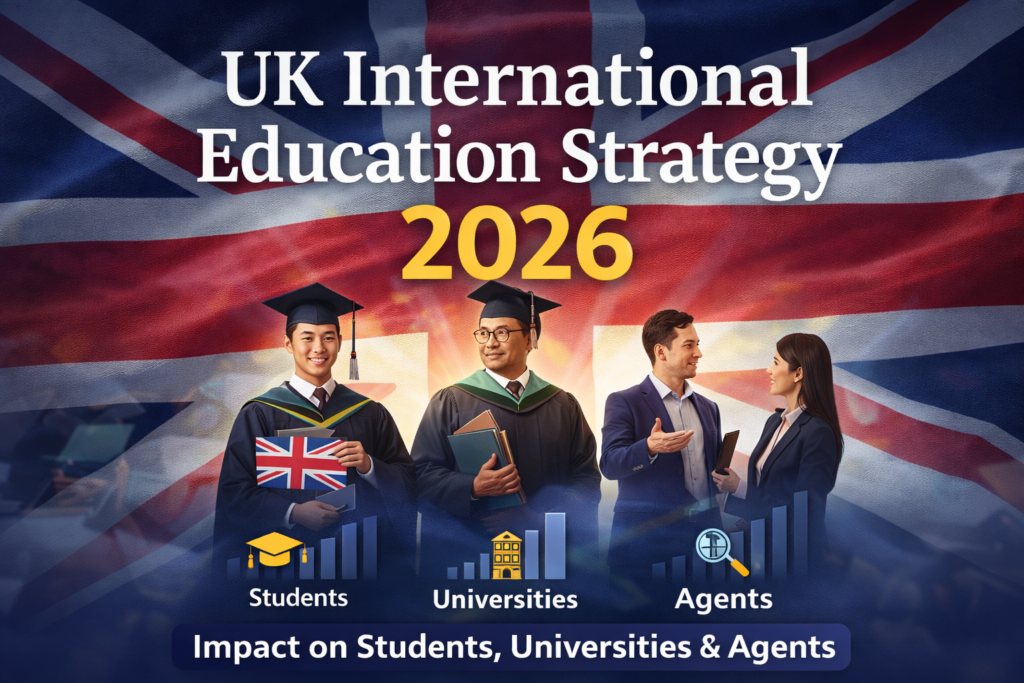
UK International Education Strategy 2026 impact analysis on students universities and education agents

Impact Assessment of the UK International Education Strategy 2026

A Strategic Impact Assessment for Students, Universities, and Education Agents The UK International Education Strategy 2026 marks a decisive shift in how the UK engages with international students and global education partners. Rather than focusing purely on growth in numbers, the strategy prioritises quality, compliance, outcomes, and long-term sustainability. This policy is not restrictive — it is selective. In this article, we break down the real impacts of the strategy on: Using data-backed visual analysis, we explain who benefits, who faces risk, and how stakeholders must adapt. Impact on International Students What Changes for Students? For genuine international students, the 2026 strategy is largely positive. The focus shifts towards: Students who choose the UK for education and employability, rather than migration loopholes, stand to gain the most. Key Takeaways for Students Impact on UK Universities A Shift from Volume to Value UK universities now face heightened accountability. The strategy rewards institutions that demonstrate: Universities that rely heavily on volume-driven recruitment face greater scrutiny. University Risk vs Opportunity Matrix Key Takeaways for Universities Impact on Education Agents The End of Volume-Only Models The strategy significantly reshapes the agent ecosystem. UK authorities and universities now demand: Agent Models vs Sustainability Key Takeaways for Agents Who Benefits the Most from the Strategy? Ultimately, the policy favours quality participants across the ecosystem. Stakeholder Benefit Comparison Final Strategic Insight The UK International Education Strategy 2026 is not about reducing international education — it is about protecting its integrity. The new hierarchy is clear: Stakeholders who adapt early will gain long-term stability, trust, and growth. Those who resist change will face increasing friction and regulatory pressure. Conclusion For students, universities, and agents alike, the message is unmistakable: The future of UK international education belongs to those who prioritise quality, transparency, and outcomes. Frequently Asked Questions (FAQs) AI-Generated Analysis Notice This article and its analytical insights were generated with the assistance of Artificial Intelligence (AI). The AI was used to summarise, interpret, and visually analyse publicly available policy information to support understanding of the UK International Education Strategy 2026. While every effort has been made to ensure accuracy and clarity, the analysis should be interpreted as an informational and analytical perspective, not as official government guidance or legal advice. The conclusions, visualisations, and interpretations presented in this article are independent analytical outputs and do not represent the views of the UK Government or any associated public authority. Primary Source Document The analysis is based on the official UK Government publication: UK Department for Education. International Education Strategy 2026. Available at: https://assets.publishing.service.gov.uk/media/696a6164448fedc1eb4248ef/international-education-strategy-2026.pdf Readers are encouraged to refer to the original policy document for authoritative and up-to-date information.

Impact Assessment of the UK International Education Strategy 2026 Read More »

Important UK Visa Updates: Increased Maintenance Funds (Nov 2025) & Graduate Route Changes (Jan 2027)

The UK Home Office has announced two major updates affecting international students — an increase in maintenance funds effective 11 November 2025 and changes to the Graduate Route duration effective 1 January 2027. 1. Maintenance Requirement Increase – Effective 11 November 2025 Starting 11 November 2025, students applying under the Student Route must show higher financial evidence to meet visa requirements. The updated figures are intended to reflect the rising cost of living in the UK. Updated Maintenance Amounts: This means that a student applying to a London-based institution will now need to show up to £13,761 (£1,529 × 9 months) in living costs, while those outside London must show £10,539 (£1,171 × 9 months). What This Means for Students: 2. Graduate Route Duration Changes – Effective 1 January 2027 The UK’s Graduate Route, which allows international students to stay and work (or look for work) after completing their studies, is undergoing a duration revision. Updated Stay Periods: Key Takeaways: How Uniexperts Can Help You Plan At Uniexperts, we stay ahead of every immigration and education update to guide our students and partners accurately. Our experienced counsellors can help you: ✅ Plan financial documents to meet the new maintenance requirements ✅ Choose cost-effective study destinations outside London if budget is a concern ✅ Understand how the new Graduate Route timeline fits your career plans ✅ Prepare your visa file and post-study work options well before these rules take effect Summary of Changes Rule Change Effective Date Key Update Impact Maintenance Funds 11 Nov 2025 £1,529 (London) / £1,171 (Outside London) Higher financial proof required Graduate Route Duration 1 Jan 2027 18 months for UG/PG students Shorter post-study stay period Source: UKCISA – Student Update: Changes to the Student and Graduate Rules , Immigration Rules Changes PDF Disclaimer The information provided in this article is for general guidance only and is based on official updates available as of October 2025. Immigration rules and policies are subject to change by the UK Home Office without prior notice. Applicants are strongly advised to verify all details from official government sources or consult with a licensed immigration advisor before making any visa-related decisions. Uniexperts assumes no responsibility for any errors, omissions, or actions taken based on this information.

Important UK Visa Updates: Increased Maintenance Funds (Nov 2025) & Graduate Route Changes (Jan 2027) Read More »

Indian Students Drive UK Study Visa Growth Amid Stricter Rules

The UK continues to be one of the world’s most attractive destinations for higher education. In 2025, Indian students are at the center of this success story. Despite tighter immigration rules and a sharp decline in dependant visas, India has emerged as the leading driver of UK study visa growth. 📊 Key Numbers: UK Study Visas in 2025 According to the UK Home Office (year ending June 2025): 431,725 sponsored study visas were granted — down 18% from 2024 but still 52% higher than pre-COVID 2019 levels. 413,921 were main applicants, representing a 4% decline from 2024. 17,804 were dependants, marking an 81% drop after the January 2024 policy restricted dependant eligibility to PhD students and government-funded scholars. Among main applicants, Indian students secured 98,014 visas, nearly matching Chinese students at 99,919. Together, India and China accounted for almost half of all UK study visas issued in 2025. 🎓 Indian Students Favor Postgraduate Programs A standout trend is India’s clear preference for postgraduate education: 81% of Indian students enrolled in master’s programs. In comparison, 59% of Chinese students opted for postgraduate studies. This reflects a career-focused approach, with Indian students viewing UK universities not just as academic institutions but as launchpads for global opportunities. 🌍 Changing Policy, Changing Student Profile The sharp decline in dependant visas has reshaped the UK’s international student demographic: Fewer families are migrating alongside students. The incoming student population is increasingly academically focused. Postgraduate enrolments are driving overall growth, highlighting a career-driven mindset. While these policy changes reduced total numbers, they strengthened the UK’s reputation as a destination for serious academic and professional advancement. 💡 Why Indian Students Still Choose the UK Even with stricter visa rules and higher living costs, Indian students continue to see strong value in studying in the UK because of: Globally recognized master’s programs Advanced curriculum and rich research opportunities The Graduate Route, offering 2–3 years of post-study work rights The UK’s global reputation for employability and career progression 🌐 The Bigger Picture: Comparing the Big Four Study Destinations While the UK attracts Indian students with a streamlined visa process and post-study work opportunities, other popular destinations are facing challenges: Canada: Tighter eligibility rules, stricter proof-of-funds requirements, and rigorous academic checks are causing delays. Australia: IT system issues and documentation delays through the ImmiAccount system are slowing visa approvals. USA: Limited visa appointments, fluctuating immigration policies, and ongoing H-1B uncertainties create unpredictability for long-term planning. United Kingdom: In contrast, the UK remains welcoming, predictable, and career-focused, making it a top choice for Indian students seeking global education and professional growth. 🔮 The Road Ahead For UK universities, the challenge will be to balance policy restrictions with global competitiveness, ensuring that ambitious Indian students continue to see the UK as their first-choice destination. Indian students are no longer just participants in the UK’s international education story — they are leading it. Their dominance in postgraduate enrollments and career-oriented outlook is reshaping the landscape of UK higher education.

Indian Students Drive UK Study Visa Growth Amid Stricter Rules Read More »

UK Universities Face Clearing Crunch Amid Decline in International Student VisasUK Updates

As the 2025 academic year progresses, UK universities are facing an unprecedented storm: a downturn in international student visa applications, financial instability, and a highly competitive clearing season. With the sector already under pressure, the latest visa statistics highlight the challenges ahead. Study Visa Trends: Signs of Strain and Recovery According to the UK Government’s official visa statistics (gov.uk), monthly applications for Sponsored Study visas have fluctuated sharply over the past three years. Peaks typically occur ahead of major intakes (July and September), but policy shifts have had a clear impact: Between January and July 2025, applications climbed from 156,800 to 177,800, a modest rebound compared to the decline seen in 2024. This suggests international interest in UK education remains resilient, though still fragile. Universities Under Financial Pressure Despite this rebound, universities remain in a precarious position. Research from RSM UK warns that the combination of policy changes, inflation, and declining international student numbers has left institutions struggling to balance their books (RSM UK). The impact is severe: This financial squeeze is forcing many universities—particularly mid-tier and smaller institutions—into cost-cutting and restructuring. The Clearing Crunch: A Fierce Competition for Students With fewer international students to rely on, universities are doubling down on domestic recruitment through Clearing. However, this has created what experts describe as a “clearing crunch.” Institutions are aggressively competing to fill available seats, often with limited resources to manage the surge. Smaller universities, which lack the brand recognition of top-tier institutions, are especially vulnerable. The competition for students has never been fiercer, with Clearing now acting as both a lifeline and a battleground. What Next? Securing Stability in Uncertain Times To navigate this turbulent period, both universities and policymakers must act quickly. Key steps include: Conclusion The UK higher education sector is at a crossroads. While early signs in 2025 show a recovery in international visa applications, universities are still grappling with the aftermath of restrictive immigration policies and financial strain. Without decisive policy changes and innovative institutional strategies, the sector risks long-term instability. The coming months—particularly as Clearing unfolds—will be crucial in determining whether UK universities can weather the storm or face deeper structural challenges. Sources & Further Reading

UK Universities Face Clearing Crunch Amid Decline in International Student VisasUK Updates Read More »

Important eVisa Update for UK Visa Customers – Work and Study Routes

The UK Visas and Immigration (UKVI) department is making a major change to how immigration permissions are granted for those coming to the UK to work or study. Starting from 15 July 2025, UKVI will begin transitioning from physical visa stickers—known as vignette stickers—typically placed inside passports, to a fully digital immigration system called the eVisa. What Is Changing? Who Is Affected? What Do You Need To Do? Why Is the UK Moving to eVisas? This shift to eVisas is part of a broader UK government initiative to build a digital border. By digitizing immigration records, UKVI aims to make the process easier for customers, reduce administration, and enhance security. For more information and official updates, refer to the UK Government’s eVisa webpage. Sources:

Important eVisa Update for UK Visa Customers – Work and Study Routes Read More »