
Date: March 7, 2026
For decades, the paper-based IELTS test has been a familiar rite of passage for millions of students planning to study abroad. However, as international education continues its rapid digital transformation, the testing landscape is evolving to match.
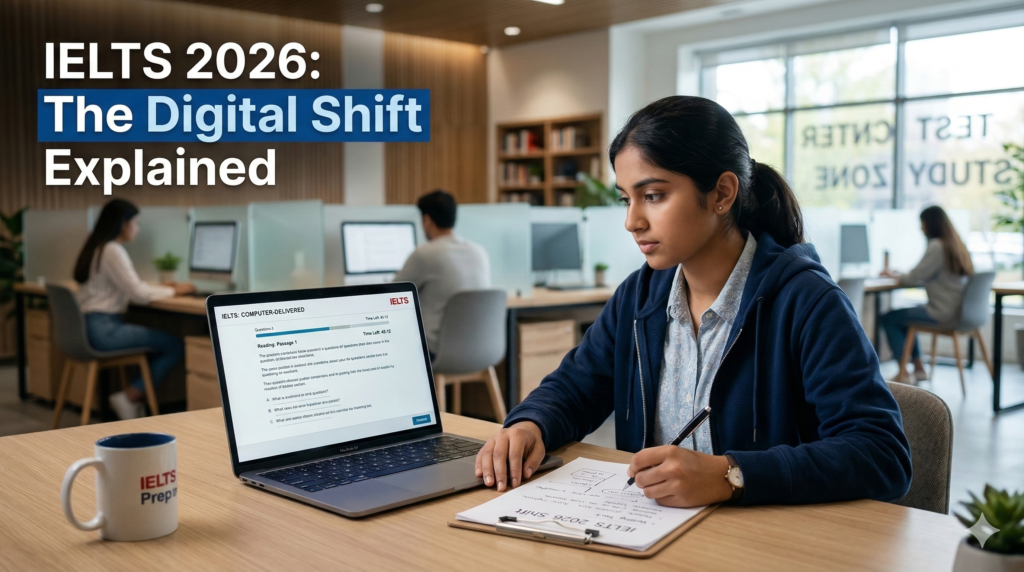
On March 5, 2026, the IELTS Partners officially announced that they will be phasing out the fully paper-based IELTS test globally [cite]. Starting in mid-2026, the test will shift almost entirely to a computer-delivered format to provide faster results, greater convenience, and access to modern features like the One Skill Retake.
If you are planning your study-abroad journey, this structural change directly impacts how you should prepare. Here is a breakdown of what the new IELTS delivery model looks like and how you can adapt.
What Changed: The Mid-2026 IELTS Update
The IELTS partners have restructured test delivery to match modern test-taker preferences, noting higher satisfaction rates among those who take the test on a computer.
- Phase-Out of Full Paper Tests: By mid-2026 (with exact timelines varying by region), the traditional fully paper-based test will no longer be offered. All baseline IELTS tests will be delivered on a computer [cite].
- The New ‘Writing on Paper’ Option: Recognizing that many students still prefer to brainstorm and handwrite essays, IELTS is introducing a hybrid option in selected markets. You will take the Reading and Listening sections on a computer, but you can choose to handwrite the ‘Writing’ component on physical paper [cite].
- UKVI Strict Digital Rule: If you are taking the Secure English Language Test (SELT) for UK Visas & Immigration (UKVI), you must take the fully digital format. The ‘Writing on Paper’ option will not be available for UK bound students requiring a SELT [cite].
- One Skill Retake (OSR) Logic: The OSR feature will be available for the ‘Writing on Paper’ option. However, your retake must match your original delivery mode. If you chose to handwrite your essay originally, your retake must also be handwritten [cite].
Note: All current paper-based test results remain valid for the standard two-year period, and Access Arrangements (like braille or large print) remain unchanged for test-takers with specific needs.
What Students Should Do Now: The 2026 Checklist
- Pivot Your Practice Materials: Stop relying solely on printed practice booklets for the Reading and Listening sections. Start using screen-based practice tests to get comfortable reading long passages on a monitor and using digital highlight features.
- Check Your UK Eligibility: If your target destination is the UK and you need a UKVI SELT, you must build your typing speed immediately. You will not have the option to handwrite your essay [cite].
- Verify Local Center Options: If you heavily rely on handwriting for the Writing task, contact your local IDP or British Council test center to confirm exactly when the ‘Writing on Paper’ hybrid option goes live in your city.
For Indian, Sri Lankan, Nepali, and Pakistani Students
Historically, students across South Asia have strongly favored the paper-based IELTS format.
- What differs: The transition to screen-based Reading and Listening may initially slow down students who are used to annotating physical paper. You must train yourself to absorb information from a screen under timed conditions.
- What stays the same: The actual IELTS construct, difficulty level, and scoring remain completely unchanged. Research confirms that scores are highly comparable across both formats [cite].
- The Silver Lining: The ‘Writing on Paper’ option acts as a great bridge for students in the subcontinent who type slowly but have excellent handwritten articulation.
Conclusion
The shift to a computer-delivered IELTS is a massive step forward, offering faster results and a streamlined experience. However, it requires a conscious shift in how you practice and prepare.
Want to ensure your English scores and university applications are perfectly aligned for the 2026 intakes? Book a free counselling call with Uniexperts today and let our experts guide your study-abroad journey.